Auxiliary Verb (Group 1) (Basic ㊦ 102)
Something that has been latent is realised.
Equivalent: Out; begin to; start to
| V ます | 話し出す | Someone starts to talk |
| 食べ出す | Someone starts to eat |
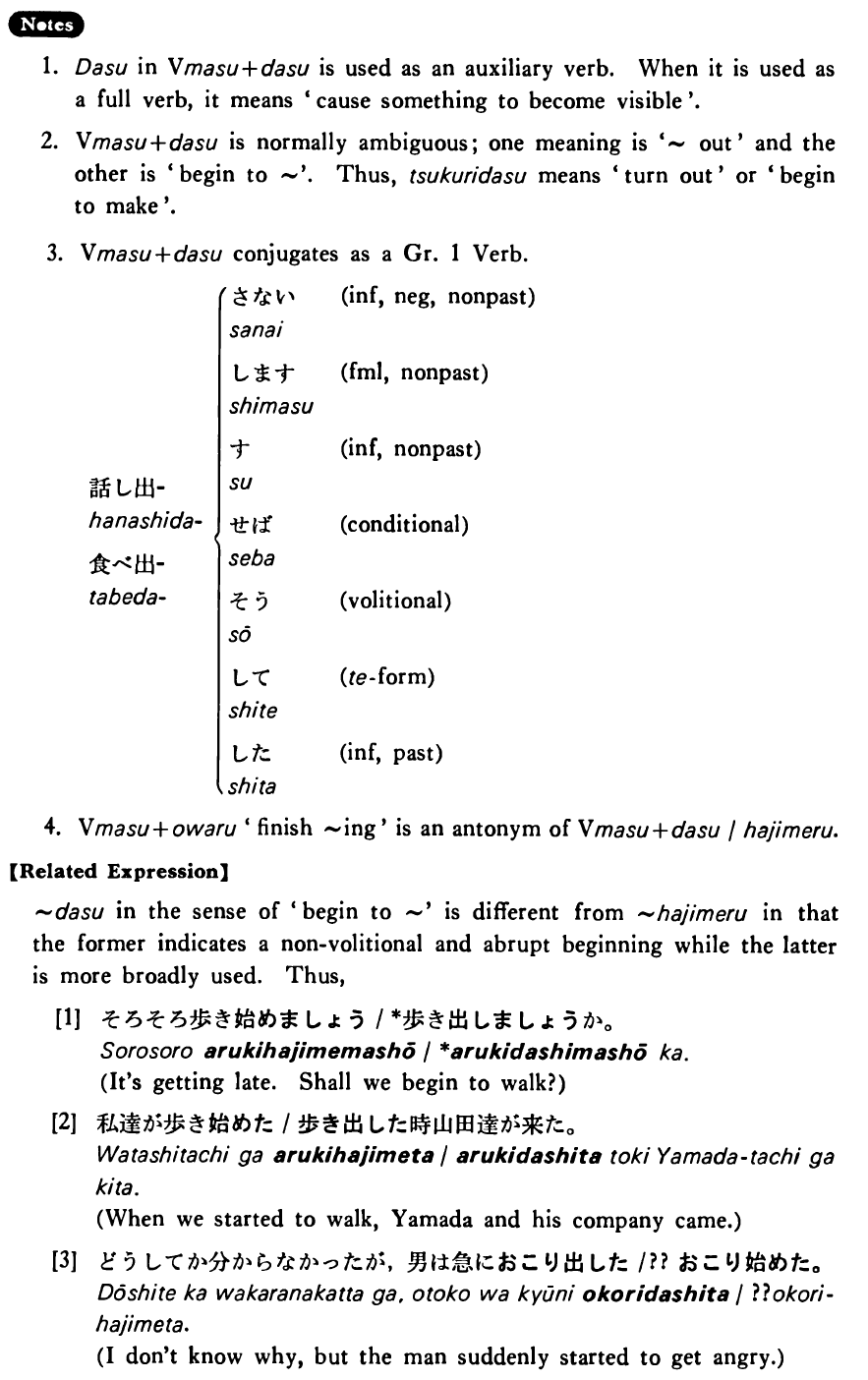
1. 出す in Verbます+出す is used as an auxiliary verb. When it is used as a full verb, it means 'cause something to become visible'.
2. Verbます+出す is normally ambiguous; one meaning is '~ out' and the other is 'begin to ~'. Thus, 作り出す means 'turn out' or 'begin to make'.
3. Verbます+出す conjugates as a Group 1 verb.
| ⎧なさい | informal, negative, nonpast | |
| ⎪します | formal, nonpast | |
| 話し出 | ⎪す | informal, nonpast |
| ⎨せば | conditional | |
| 食べ出 | ⎪そう | volitional |
| ⎪して | て form | |
| ⎩した | informal, past |
4. Verbます+終わる 'finish ~ing' is an antonym of Verbます+出す/始める.
【Related Expression】
出す in the sense of 'begin to ~' is different from 始める in that the former indicates a non-volitional and abrupt beginning while the latter is more broadly used. Thus,
[1]
[3]